

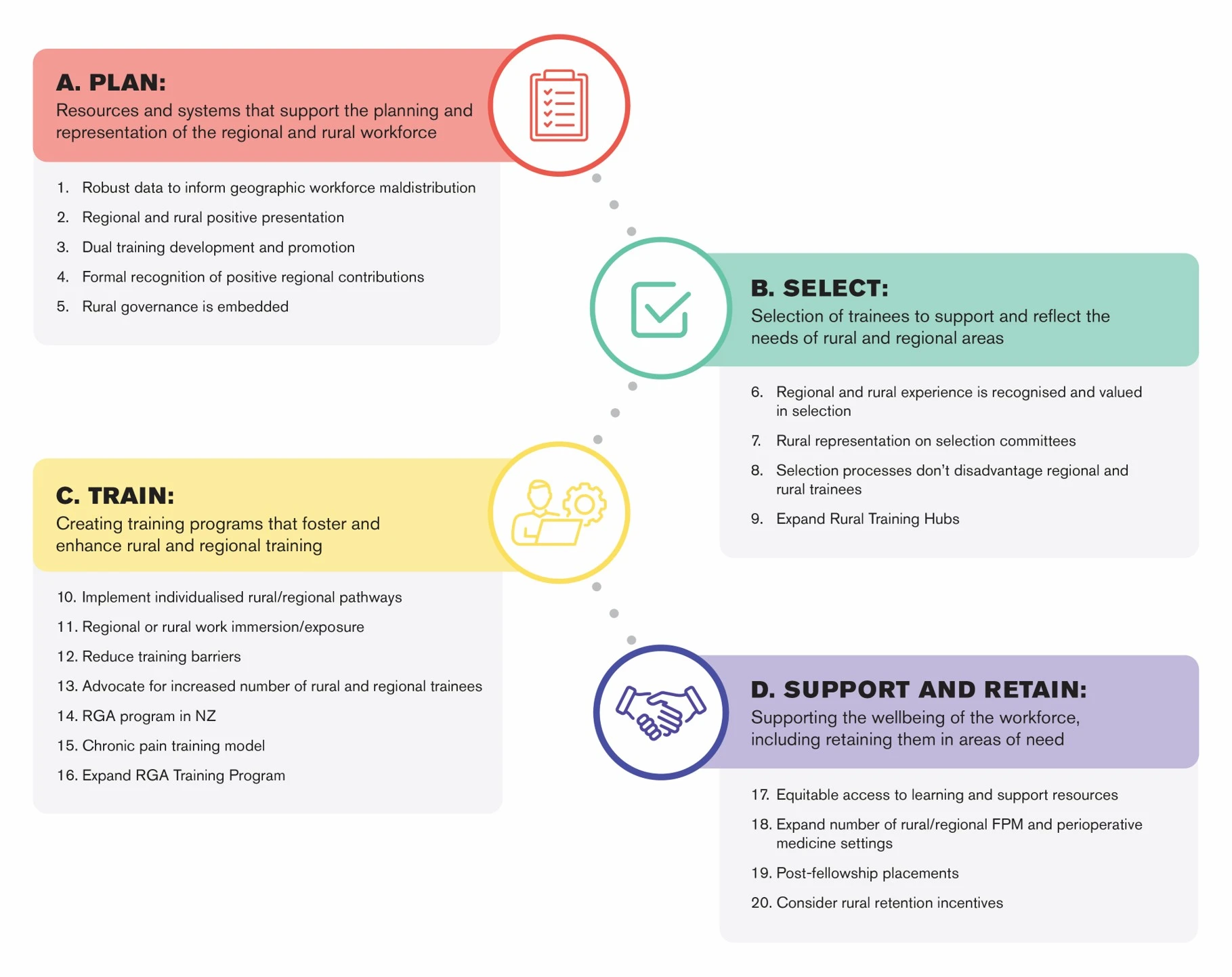
The four strategic pillars
Our progress so far
The strategy also highlights the college's significant achievements since the launch of our inaugural regional and rural workforce strategy in 2021. The college has made tangible progress on many regional and rural initiatives:
- Establishing the Rural Generalist Anaesthesia (RGA)Training Program, with the Australian College of Rural and Remote Medicine (ACRRM) and Royal Australian College of General Practitioners (RACGP) that enables patients in rural areas better access to surgery.
- Embedding rural based anaesthesia training pathways and rotations. These pathways enable trainees to undertake 70-80 per cent of their training in regional/rural settings, with a metropolitan advanced training rotation to fulfil complex training requirements. This approach recognises doctors who train in rural and regional areas are more likely to establish careers there.
- Broadening pain medicine training opportunities in regional areas via flexible accreditation pathways pilot across regional settings.
- Developing targeted advocacy, promotional representation of positive regional and rural training lifestyles and professional development resources to support regional and rural practice. Some these have included the Planning for success exam preparation resource, Critical Incident Debriefing Toolkit, Masterclass in effective communication, and Beyond City Limits articles.
Explore this section
The Specialist Training Program (STP) is an Australian government initiative that aims to extend vocational training for specialist registrars into settings outside traditional metropolitan teaching hospitals, including regional, rural and remote and private facilities.
Explore a range of training and professional development resources for our trainees, fellows and SIMGs, initially developed with the rural and regional workforce in mind and based on stakeholder surveys.
Access specialist library resources and services for anaesthetists and pain medicine physicians working in or with an interest in rural and remote medicine.
Learn about scholarships, grants and external funding opportunities for rural and regional trainees, fellows and SIMGs
Educational and networking events with strong relevance to the regional and rural workforce.
Rural generalist practitioners with training in anaesthesia play vital roles in providing life-saving services to patients in many rural and remote communities across Australia.
The Rural SIG is one of 17 SIGs jointly managed by ANZCA, the Australian Society of Anaesthetists (ASA), and the New Zealand Society of Anaesthetists (NZSA) through the Anaesthesia Continuing Education (ACE) partnership.
A regular series showcasing opportunities for rural anaesthesia training and careers in Australia and New Zealand.